Showing posts with label mobile marketing. Show all posts

Monday, February 9, 2015

Goodbye Menu Navigation

"Ok, grab a clean sheet of paper and let's write down everything we want in our new demo website."
"What's paper?"
That's not the exactly the way the meeting started, but you get the point. Technology is changing so fast, some days it is difficult to keep track of what is available and what is not.  Thrive IM is in the beginning of designing the next generation YMCA website.  A group of us were gathered around the conference room trying to beat John to the pizza.  
On the wall we were staring at the existing demo site on the 60" monitor. The problem we were discussing was navigation and sub-navigation.  From a user's perspective, how should the navigation flow?  What is the most logical progression that would let the site visitor find the information they needed in the most efficient manor? Horizontal navigation or vertical?  Fanned sub-nav or accordion?  
"I think we are looking at this from the wrong perspective.  We already know that traffic to YMCA websites is mirroring traffic to other sites.  More than 50% of existing website traffic to YMCA websites now comes from smartphones and tablets. The question we should be asking is how can consumers find the content they seek on a smartphone?"
And suddenly the answer was there.  Search.  Voice search.  You reach your local YMCA site and have a choice.  Start reading menu options and clicking on the navigation icon you "think" will reveal the answer, or...
Tap the microphone icon and ask the web site "When does summer camp start?" And almost instantly your smartphone takes you to the information you want on your local YMCA website .  Almost Watson-like, it reports "there is a 93% chance that the answer you seek is Friday, June 13th.  Would you like to register now?"
Sometimes we forget that a smartphone is still a phone.

Tuesday, January 13, 2015

The Interview Continues - Mobile Marketing

Part two - An interview with Deepak Kanakaraju and published on DigitalDeepak.com.  Due to the length, I will post the interview over a series of blog articles.


What are the top 3 things to look out for when it comes to mobile marketing?


Bonus time!  Here are five points to consider when marketing through mobile devices.


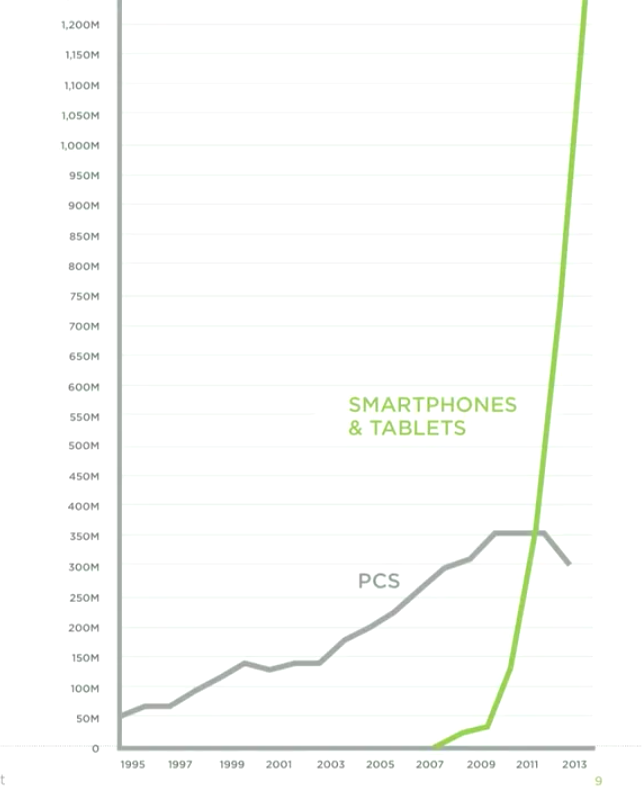
Mobile marketing will be the most important marketing trend over the next three to five years for a variety of reasons.  The biggest reason is that consumers are in control of the process.  Below is a graph that tells you how important mobile marketing is today.  PC sales peaked in 2011 at 350 million units worldwide after 29 years of sales (since 1983).  Seven years after launch, smartphones and tablets have sold more than 1.2 billion.


If you are not focused on mobile, you need to start now.  Next to the fact that everyone has a mobile device today, the biggest factors in mobile marketing are:


  • You must have a mobile website.  Websites designed for a width of 1920 pixels will not display on a smartphone, which on average has 320 pixels.  Or it will and be so small that the web site is useless.  Recently I did an analysis of 22 websites comparing the bounce rates of responsive versus non-responsive websites in the YMCA.  On average, the bounce rates for responsive (mobile friendly) websites were 14% lower than non-responsive web sites.
  • Develop specific mobile landing pages for your offer.  Mobile marketing is no different than traditional website marketing.  You must deliver the sales prospect to the information/product/service they are looking for in as few clicks as possible.  “Looking for X?  Click here.  Hello X!”
  • You must profile and target the right consumer.  Mobile targeting is rapidly becoming as efficient as desktop targeting, even without the use of cookies, using contextual targeting (based on matching the consumer’s interest with the website’s content) and geo-targeting (based on the physical proximity of the consumer to the business).
  • It costs more, but Location Based Mobile Advertising is worth it.  Also known as geo-fencing or geo-targeting, it gives the advertiser the ability to use the GPS functionality of today’s smart phones to target consumers.  Smartphones track where you go.  Own a restaurant?  You can erect an invisible, digital fence around your restaurant and advertise within a one mile radius of your location.  “Save $1 on any sandwich today!”  Or erect a fence around your competition.  Or target the football stadium for the after the game crowd.  Smartphones even keep a list of where you have been over the previous 60 days.  I have worked with new car dealers who target consumers who have visited two or more dealerships in the previous 60 days.  They know these individuals are in the market for a new car.
  • Finally - It’s a phone.  Smartphone. Take advantage of Click to Call.  Show an ad.  Take the prospect to a mobile landing page and tell them - press this button to talk now.  One of the smartest campaigns I have worked on was for a university, targeting high school students.  The landing page said “My name is Jeff.  I am your enrollment counselor.  Press here to talk to me.  Click here to send me an email.”  Three weeks into the campaign they had to add more counselors to handle the call volume.

When reporting on the increase in the consumer’s time spent with digital media, eMarketer reported, “The most significant growth area is on mobile. Adults will spend an average of 2 hours and 21 minutes per day on non voice mobile activities, including mobile internet usage on phones and tablets - longer than they will spend online on desktop and laptop computers, and nearly an hour more than they spent on mobile last year.”

Thursday, December 18, 2014

How Beacons Send Ads To Your Phone

I could add some information and comments, but this article does a great job of explaining how beacons work in eight simple slides!


From Start To Finish, This Is How Beacons Send Ads To Your Phone While You're Shopping


Read more:  http://www.businessinsider.com/how-beacon-ad-campaigns-work-2014-12?op=1#ixzz3MGCHimu0

Tuesday, November 25, 2014

Mobile Traffic Reaches 50%. Does it Matter?

“The very best marketing comes from observing consumer behavior and inserting your message into their behavior.”

Recently I reviewed the Google analytics for 22 YMCA web sites to identify consumer traffic trends for 2014.  Research from eMarketer indicates that consumers continue to move their web access device of choice to mobile (smartphones and tablets).  “Combining online and mobile devices, however, eMarketer expects US adults to spend 5 hours 46 minutes with digital media daily this year, increasing digital’s lead over television to well over 1 hour per day.  That increase is almost exclusively attributable to mobile.”

I wanted to see the impact, if any, on the traffic to YMCA websites. Many businesses are now reporting that more than 50% of their site traffic is coming from mobile devices.  It makes sense, smartphones have outsold computers since the 4th quarter of 2011.  

These analytics covered 2.1 million web sessions from January 1st to November 23rd, 2014.  

We Are Going Mobile

  • During the first six months of 2014, mobile traffic represented 46.2% of all traffic to these YMCA websites.
  • From July 1st to November 23rd, mobile traffic represented 49.4% of all traffic, an increase of 7%.  Clearly consumers are increasing their use of mobile devices to access YMCA websites.
  • Seven of the 22 web sites already generate more than 50% of their traffic from mobile devices.
  • Based on current trends, it appears that mobile traffic will account for more than 50% of all YMCA traffic by the end of the first quarter of 2015.

Does It Matter?

What does this change in traffic mean to the “average” YMCA, if anything? This analysis includes a cross section of YMCA sites: 14 traditional web sites and 8 responsive design (mobile friendly) websites.

Mobile traffic for responsive design websites increasingly represents a larger portion of total site traffic.  Mobile traffic in responsive design sites is 46.7% of all traffic versus 45.8% of non-responsive sites. When consumers have a more engaging experience, they will visit more often and stay longer.

This may be a small difference, but the real difference comes from looking at the variances in bounce rates.


Bounce Rates


January - June
Traditional
Responsive
Variance
Smartphones
53.40%
46.70%
14%
Tablets
44.70%
37.90%
18%


July - November 23rd
Traditional
Responsive

Smartphones
54.40%
47.68%
14%
Tablets
44.44%
39.57%
12%


Clearly the bounce rates are lower for responsive design sites. Responsive (mobile friendly) design leads visitors more easily to the content they are seeking.  

Your website is your digital storefront and for many member prospects it is their first impression of your organization.  Upgrading your website to responsive design (or at least offering a mobile site) is no longer an option. Consumer behavior now dictates it.

Friday, November 21, 2014

Turning Mirrors Into Windows


comScore reported in June that 60 percent of all online traffic now comes from mobile devices.

That is a 50 percent increase from the previous year.


Over the previous four weeks I have reviewed approximately 60 web sites for clients and prospective clients and none (zero) have a mobile friendly web site.  So I asked them what their plans were to make their websites mobile friendly for their clients and their sales prospects.  Here is a fairly typical response...

"Thanks so much for getting in touch.  We did redesign our website a few years back and are currently happy with it.  There are areas for improvement, but it isn't our priority this year or next year."

Ian Hartten is found of reminding me that we have "elected to join the fastest changing industry in history".  At times I admit that it is difficult to keep pace with all the changes.  But as digital marketers, it is our burden to keep pace.  And "the very best marketing comes from observing consumer behavior and inserting your message into their behavior".

Everyone I spoke to believed people were using mobile devices to access the web, but all were shocked at the accelerated pace at which this phenomenon had occurred.  Their decision to not have a mobile friendly website was not a conscious decision. It was a "sin of omission".  They simply did not realize how fast this change in consumer behavior had come about.

Mobile web traffic was measured at 20 minutes per day in 2010. By 2013 it rivals the amount of traffic generated by desktop devices, almost a full two hours per day more than in 2010.


This represents the fastest adoption of a media device in history. 

They didn't know because we hadn't told them.  A large part of working in the "fastest changing industry in history" is sharing knowledge.  Education.  Its all part of the job.

Be sure and share what you learn with others.  

"The whole purpose of education is to turn mirrors into windows."  Sydney J. Harris


Wednesday, June 11, 2014

When is a Smartphone Just a Phone?

I received an interesting request today from one of the advertising agencies I work with concerning a client campaign. 
 
"Can we pause their mobile campaign?  They are happy with the CTR (Click Through Rate), but not their conversion rate.  Any ideas on how to improve this?"  So I paused the campaign and went to take a look.

This campaign is complex and is designed to recruit volunteers to work with disadvantaged youth.  The targeting is impressive.  Hispanic females, age 40 to 65, high school diploma or more, bilingual, +$50K income...  Targeting ten cities throughout the state...  Mobile is a great way to target this specific community.

Looking at the landing page we were directing traffic to, I believe they could leverage the campaign to take advantage of the medium they are advertising on.  This is a mobile campaign and they have no way for an interested individual to call for more information.  They are simply directing traffic to a mobile enabled version of their desktop web site.

This is ironic because the creative asks several times “ready to speak up for a child who needs you?”, but there is no way for the individual to speak to an employee of XXXX (or a fellow volunteer).  If you do scroll all the way to the bottom of the page you can find an office phone number in font size that I have difficulty reading. 

We just finished running a campaign for a local university targeting high school students.  For the landing page they built a campaign specific landing page (not a link to the regular web site).  If you were a high school student looking at a college ad and were interested, what would be the next logical step you would expect?  Access to answers.  So each high school was assigned to one of two specific enrollment counselors at the university.   When you clicked on the ad, depending on your school, you saw a landing page with three simple elements.  “Hi, I am Jeff.  I am your enrollment counselor and I am here to answer any questions you may have.”  And there was a picture of Jeff with the following two options.  “Click here to talk to me.”  “Click here to email me.”

Three weeks into the campaign, the university contacted me asking if they could add additional counselors to handle the volume. 

People do business with people, and I believe that a personal commitment like volunteering to help children at risk is a harder decision than ordering new shoes online.  And mobile phones offer a call to action that is superior to any other medium (TV, radio, print, yellow pages, email, desktop ads) – with one click you can talk to someone.

With digital marketing, the click to a web site is only the beginning.  In many ways, it is the easiest part of the campaign.  But we have to look beyond the click and identify the obstacles to achieving the desired goal.  In this case - engagement leading to enrollment.  And for all the excitement about mobile devices taking over web traffic, remember - a smartphone is still a phone and then in lies the competitive advantage of a mobile campaign.

Thursday, June 5, 2014

“It doesn’t do any good to sit up and take notice, if all you do is keep on sitting.”


“The very best marketing comes from observing consumer behavior and inserting your message into their behavior.” 

eMarketer released a report today – “USMobile Ad Dollars Shift to Search Apps” – that shows that several marketers are certainly taking this to heart – at Google’s expense. 

It is no secret that Google has owned the Search category on desktops “forever” with a share of voice in the mid-60’s.  And as the consumer moved over to mobile devices, Google was at the forefront of mobile search.  In 2012 it was estimated that Google had a +82% share of the mobile search market.  eMarketer is reporting that Google’s mobile share has dropped to 68% in 2013 and much of this decline has occurred because of a shift in the behavior of mobile consumers. 

Part of this shift is occurring because of the increased use of mobile apps for search.  They are projecting that apps like Yelp are taking a bite out of Google’s dominance.

“App-based searching is a new phenomenon that pales in comparison with the longstanding practice of querying a search engine, and the degree to which mobile users rely on both methods for finding information is unclear,” Boyle added. “Still, in light of the growing popularity and time spent with apps, search marketers that recognize this behavior and focus on increasing visibility within apps aligned to their industry and business objectives will be best positioned to connect with the largest number of mobile users.”

The desktop versus mobile web site debate is dead.  While it is not time to abandon the desktop web site, as mobile traffic grows, it is time for businesses to quick “thinking” and “start doing” something about web sites that are not mobile friendly.  Personally, I can’t imagine designing a web site that fails to support the soon to be largest segment of web traffic (mobile) and segment that is growing (mobile).  It is the equivalent of building a web site that doesn’t support English.

“But I have all this money sunk into my legacy web site and it will cost a large/medium/small fortune to convert it to mobile responsive.”  And I have a closet full of double breasted suits and wide/skinny ties.  It doesn’t matter… 

Last month I analyzed the web sites of 20 clients/prospects.  17 of them do not have a mobile enabled web site. 

·       Overall 30% of web traffic now comes from a mobile device.  For many businesses the amount of mobile traffic is already more than 50% (ask someone in the news media).


·       Smartphones outsell desktop computers and have since the 4th quarter of 2011.


Need +100 more reasons to stop thinking and start acting, click here - Mobile Industry Statistics

 “It doesn’t do any good to sit up and take notice, if all you do is keep on sitting.”

Friday, April 11, 2014

Seven Facts Marketers Need to Know About Mobile Users

Since we have spent some time talking about mobile marketing and geo-fencing over the past two weeks, I thought I would share a great article I found on MarketingProfs.com.  Thank you Greg Webster for sharing.
 
1.   Mobile users are driven by the fear of missing something (FOMS).  This is the primary reason we check our phones so often. 
 
 
2.   Mobile devices are most used during “found time”.  On the way back from lunch today, Lewis, J.J. and I were talking about the good old days when you came back to the office to a stack of pink message forms.  Of course we were all checking our cell phones at the time looking for missed calls, texts and new emails.  Today if you have a moment of unused time, it is considered the perfect time to check your phone.  And instead of “thinking”, “reading” or “daydreaming”, we now kill time with a  mobile device.
 

3.   People pick up their smartphones upwards of 100 times every day.
 

4.   Mobile users spend more time on the home screen than any other screen – a staggering 26% of their time.  This is a message that more of us should pay attention to.  It is not only important to get your app downloaded, how do we get the consumer to post it on their Home Screen?
 

5.   Users respond to mobile alerts.  92% will pick up their device to check a missed call.  88% will pick it up to check a missed text. Another great reason to use mobile push alerts…
 

6.   Notifications drive behavior.  51% of smartphone users strongly agree that the first thing they do when they pick up their handset is check their notifications.  Mobile push alerts!
 

7.   The longer you have owned a smartphone, the more likely you are to pick up your phone and check for messages.
 
“The very best marketing comes from observing consumer behavior and inserting your message into their behavior.”


Friday, March 28, 2014

Yes Virginia, We Are Tracking Your Mobile Phone

So what are some ideas for geofencing?  I ran a campaign in Ohio for a community college.  We geofenced seven universities/colleges with a one mile radius and distributed ads to students in the spring.  The message?  “Take classes this summer at the community college at half the rate of the university.  And all class credits are 100% transferable towards your university degree!” 

If you owned a restaurant and wanted to increase your lunch business, geo-target your competitors and serve up a strong call to action – “Save $Xxx on lunch today!”  The beauty of mobile geo-targeting is that it identifies the mobile device’s location below the zip code level and you can customize the size of the targeting area.  Here is an example of targeting the competition.  Your ads only run in the blue geo-fenced areas of your competitor. 


Target an event at the AT&T Center, Sea World, Six Flags, North Star Mall, UTSA, USAA, Valero Texas Open, NBA Finals, Texas vs. Baylor.  Thousands of people gathered at a single event makes a great opportunity to reach an unique audience all at one time.  “Leaving Sea World and looking for a great meal?” 

I have a client with an interesting opportunity.  While they are a market leader, they are in an industry plagued by a constant need to hire new employees to handle the increase in business.  Since they need employees with a particular skill, geofence the competition with a “Now Hiring” campaign. 

Targeting Based on Location History.  Smart phones today track where you use them and stores the data for 60 days.  Don’t believe me?  On your iPhone, view Settings, Privacy, Location Services and scroll to the bottom to System Services and select Frequent Locations.  At the bottom of this screen it will show you where you have been using your phone – talk, text or data – for the previous 60 days.   

If you sold automobiles, would you like to target people who have visited three or more competitors in the previous 60 days?  The only people who visit auto dealers this frequently are probably in the market for a new car.  We can target these individuals using their location history. 

For an auto repair company, we are targeting high mileage drivers by identifying individuals who filled up at gas stations 5 times or more in the previous 60 days within their 3 mile trade area.  

A pizza company used the weather activated feature by outlining their delivery area in advance.  When it started raining, they advertised “Stay inside.  We will bring dinner to you.”

How about a campaign that takes advantage of our ability to dynamically change the ad based on your current location?  For a food manufacturer we suggested an ad that changes the closer the individual is to the store selling the product.  “Only one mile to Bob’s market!”  As the prospect gets closer to the store the ad dynamically changes to “Only ½ mile to Bob’s Market!”  “Only 500 yards to Bob’s Market!”  Add in a mobile landing page with two buttons.  Button one outlines the step by step directions to Bob’s Market.  The second button offers a 50 Cents Off Coupon.  Simply press the button and the coupon image is saved to your photos folder on your phone.  Then you just show your coupon photo to the cashier! 

And lest we forget, this mobile device is also a phone, so for many clients, a “click to call” button is perfect. 

"Though no one can go back and make a brand new start, anyone can start from now and make a brand new ending."
    Carl Bard