Showing posts with label digital advertising. Show all posts

Thursday, February 26, 2015

Consumer Behavior - Key Metrics By Device

"The very best marketing comes from observing consumer behavior and inserting your message into their behavior."

Whether you operate a YMCA or other business, mobile is here to stay.  What is not certain is whether or not the desktop will be here in any measurable way in five years.  Mobile marketing will dominate website access because consumers are in control. Simply put, consumers are buying mobile devices, not PCs.

PC sales peaked in 2011 at 350 million units worldwide after 29 years of sales (since 1983). Seven years after launch, smartphones and tablets have sold more than 1.2 billion units.

On June 29th, 2007 the iPhone was introduced to the world. Today one third of all high school students have an iPhone.  

eMarketer has just published their Chart of the Week showing Key Metrics by Device for the 4th quarter of 2014. 


Based on the 2014 holiday selling system, it confirms what we already suspected.  

Mobile devices now account for 44.3% of all web traffic, but 75% of revenue still comes from desktop devices.  There is something comfortable about the desktop when it comes to placing an online order.

But the tablet is rapidly becoming a device of choice. Average time of site for a tablet (a sign of engagement) is 4:34 versus 4:38 for the desktop. The average pages per visit gap is also tightening up - 8.3 pages for the desktop, versus 7.3 for the tablet.  And the bounce rate for desktops is 33% versus 37% for the tablet.

Is it possible that consumers are doing the research on a tablet and then placing the order on the desktop?  Maybe not.  The average order value on a desktop is $133.17 and $131.07 for the tablet.  

I suspect that by the fourth quarter of 2015, the tablet may be clear winner, especially since tablet and "phablets" continue to outsell the traditional desktops.

Smartphones generate twice the traffic of tablets, but slightly less revenue than the tablet.  This supports the notion that consumers are using smartphones as research devices while visiting stores and shops. This is another trend that will change as the consumer feels more secure about retail transactions on mobile devices.  

The lesson to be learned?  Mobile commerce is here. You have no choice - your website must be mobile friendly and increasingly this means responsive web design.

Or your business will be left behind.  "Mutability is life's sole constant."


Monday, January 19, 2015

The Fallacy of Focus Groups

Another headline ripped out of Harry Beckwith's Selling the Invisible. If you have read any of my other posts, you know I am in my annual re-read of one of my top five favorite books of all time. Thanks again Harry!
The idea of a focus group seems solid. Gather a group of consumers. Show them your brilliant idea. Let them tell you why it will never work, never sell, never go anywhere.
There are several well known problems with focus groups.
  • A dominant personality can overshadow others in the group. There goes the group feedback.
  • Focus groups are conducted in an artificial environment which can make it difficult to extrapolate the results into the real world.
  • Forward thinking is not a strong suit for focus groups. To my knowledge, no significant new product or service has ever been championed by a focus group. In fact I shudder to think the ideas that have been mauled to death by a focus group.
Which brings me to Dan Conetta. Dan is an individual who has greatly influenced my thinking over the previous 30 years.
I was working for Dan in the convenience store business 30 years ago as a merchandiser. I was young and anxious to make a good impression. So almost everyday I would visit the competition and see what new products they were rolling out. "Dan - 7-11 is trying a deli at the the store on 49th Avenue." "Dan - Stop and Go has an ATM at their beach location." I am fairly certain I was wearing him out when he called me into his office one day.
He wanted to know why I was so obsessed and spending so much time watching the competition. I told him I was looking for good ideas for our stores. Revenue generators!
And to this day I remember what he taught me. Jeff - you are playing follow the leader. Just because the competition does something does't mean that we should. The danger of playing follow the leader - what if the leader is an idiot? The companies you are following are a lot bigger than we are. They can afford to make mistakes that we can't.
You are a smart guy. Wouldn't you rather succeed or fail based on programs you developed, rather than copying someone who may be an idiot? There is nothing wrong with failure, as long as you learn from it and don;t make the same mistake twice.
Why don't you channel this energy in a new direction. Let's focus on the following the customer. See how they behave and then develop our own products and services based on their behavior - not the competition.
"The very best marketing comes from observing consumer behavior and inserting your message into their behavior."
This approach has worked for thirty years and it appears it is still working. Focus on the consumer's behavior.  I think I will stick with it.

Friday, January 16, 2015

Display Ads and The Sky Is Falling

Part Four and that's all folks.  Conducted by Deepak Kanakaraju and also available on DigitalDeepak.com.


Display ads worldwide seem to have very low CTRs. People are developing ad blindness, what do you think is the future of display ads?


The Law of Familiarity is at the core of any successful advertising campaign.  Simply stated, the more familiar a customer is with your product or service, the more likely they are to do business with you.  It is one of the reasons politicians put out hundreds of posters and signs near the polling stations.  They know that when you are standing in the voting booth looking at a choice between two or more politicians, you are more likely to vote for the name that is familiar to you.  


I believe that banner ads still offer value to advertisers.  Not the Run of Site ads that are sprayed across any website that will cut a deal for the advertiser (More ads, cheaper ads, to the wrong audience is not a bargain) but on sites that are selected for their unique content.  Every website has a unique audience of visitors.  Speaking to this unique audience is why the website was launched in the first place.  Find the websites that your particular audience frequents.


For example, if you are looking at media websites and wondering which network TV site to buy, you should start with knowing your target audience.  If you are looking for an older crowd, you would start with CBS.  They have the oldest average audience among the networks.  If you are looking for the youngest, you should probably look at FOX, they have the youngest.


One of the reasons CTR are very low is that media buyers first need to know the demographic and psychographic makeup of their target audience and then measure it against the makeup of the audience on the website they are looking to buy.


I believe that if you ask a visitor if they want to view ads while they navigate the site, the answer is always going to be no.  If you ask them if they want to pay you in order to visit your site, the majority will again say no.  Everyone wants something for nothing.


But if you place ads that are related to the content and interests of the site - that the visitors find relevant to their own likes and dislikes, the ads will not only be tolerated, they will also generate better results (measured by the CTR)).  


This is why Borrell shows the spending on Targeted Display will rise from 30% to 70% of online spending over the next three years.  You must match the ad to the audience.  And there are a lot of new ad types that work hard to engage the viewer - like Liquidus -  that capture the viewers attention with an ad unit that can show large groupings of inventory in a single ad unit.  They are popular with real estate, automotive dealers, furniture stores, etc.  To the average viewer - they will exhibit ad blindness, but to someone in the market for real estate, the ability to see a carousel of homes for sale, targeted by the neighborhoods that are a match, in their price range - it is the best of all worlds.  


One of the other things that bothers me about the concept of ad blindness is that the CTR has become the metrics without giving attribution credit for the millions of impressions that have been generated by the banner ad.  The Law of Familiarity says that people are more likely to do business with companies with which they are familiar.  I am convinced that these millions of impressions (assuming the creative is on target) can drive specific behavior, even if it is not a click.  Perhaps the sales prospect saw the ad, it reasonated with them, they remembered the brand and later went to Google.com and searched for it.  Nothing operates in a vacuum.  


When I first launched InspectValue.com in 1999, I experienced click through rates of 16%-20%.  No that isn’t a typo.  As the newness of the web wore off on consumers, the CTR dropped.  It became more difficult to convince consumers to click on ads, but it never became impossible.  We simply have to work harder with our targeting and messaging.


Your ideas on content marketing, social media marketing and email marketing?


While there are multiple strategies on how to drive traffic to a specific website, the most efficient and productive way is to post compelling content.  Content not only drives recognition from search engines like Google, it draws in the proper audience of consumers; individuals who are interested in your products and services.  Isn’t that the primary goal of having a web site?  


On the SEO side, ask yourself, who is the primary client of search engines like Google?  The answer is not advertisers, it is people, with a problem.  Google wants to solve that problem.  The consumers search for appropriate information is their primary business.  Jeff wants to buy shoes, Google wants to make sure it offers up the perfect solution to Jeff’s desire to purchase shoes.  Every decision tree in Google’s algorithm is driven by this goal.  


So on the business side, your efforts should be driven by the same decision tree.  What can I do to get Google to recognize me as the preferred answer to Jeff’s shoe question?  The answer is not artificially building backlinks, buying links, stuffing your pages with keywords or any of the recognized blackhat marketing tactics.  The very best SEO strategy is to develop killer content, focused on the business services and products that you offer and continue to update that content constantly.  I believe one way to achieve this is to publish a blog.  Blogs offer fresh content in a way that demonstrates your expertise in solving specific problems.  And believe me, Google is looking!


So where does social media fit in?  There is growing evidence that an active social media strategy increases your SEO results.  Who cares?  I am all for social media sites.  They help you maintain a presence in the consumers mind (The Law of Familiarity) and they can also drive traffic to your primary online business - your website.  But social media’s strongest offering is the ability to listen to your customers.  Your former customers.  And hopefully your future customers.


Listening is what “social” means.  It is not designed for advertising (even though social media platforms offer advertising programs), it is designed for communicating.  Talking.  Listening.  Not planning your next message and scheduling it for distribution next Tuesday at 5:37pm (because that is when most individuals check their Twitter/Facebook/Google+ accounts.


Listen.


One of the problems with social media rarely talked about is that you are building your business on someone else’s property.  As explained in The Malling of America, you are investing your marketing efforts (time, energy, money) building the business of the social media platform.  You are “renting” space on their website.  What happens when they decide to raise the rent beyond what you can afford?  


Which brings us to your question about email.  From a business revenue point of view, email is powerful.  Email is the only opt-in marketing program available online.  “I like your products, please make sure I am updated anytime you have something to tell me.”


No one asks for advertisements on social media platforms or websites.  If you asked a consumer, they would tell you to abolish all advertising.  Except for opt-in email.  

Ironically, while the frequency of sending emails varies from one extreme to the other, I find that most small to medium size businesses send email too infrequently.  They will ply the trades with countless advertisements to uninterested consumers, but are afraid to market to their own clients for fear of scaring them off.

Thursday, January 15, 2015

The Interview Continues - Video Marketing

Part three - Once again the full interview by Deepak Kanakaraju is available at DigitalDeepak.com.  

What is your idea about video marketing? How is it impacting digital marketing?


Video Marketing is the single most under utilized platform in digital marketing.  And it could very well be the most powerful.  Sight, sound, motion, emotion with a clickable link!  I believe that in many ways it is more powerful than TV.


In the US, I believe that the rapid growth of video consumption stems from the fact that we are inherently lazy.  People would rather have someone read them a story, rather than having to read it themselves.  I spent five years at the local FOX TV station.  When I started, our average time on site was in the 2 to 3 minute range - average for all other media websites.  We started adding videos to the site and the time on site started rising.  Soon we were experiencing an 8 minute time on site.  The more video content we added, the higher the time on site.  When reporters complained they couldn’t get their stories “on air” we told them we would publish every story they developed online.  This accomplished several things.  Now junior reporters could develop their digital portfolio.  The more they posted, the better the stories.  Reporting skills rapidly improved.  And consumers responded by staying on our website longer.  Twice our web site averaged a time on site of more than 20 minutes and ranked among the top 25 media sites in the country for time on site - a FOX station in Toledo, OH - market 73 in size in the country.


Video marketing has the ability to target specific sales prospects based on behavior and demographics and this targeting ability is stronger online than on TV.  And the online call to action response is more immediate than with TV.  Granted with dual screen behavior, the TV response is getting closer to the native online response, but you still have to try and follow the message on the TV and try to catch up on the mobile device.  “What was that URL again?”  Online you simply click on the video to learn more.


One mistake I see marketers make is the idea that “I have a TV commercial, I’ll just throw it online!”  I believe this weakens the consumer response.  You don’t see advertisers taking a print ad and throwing it up on a billboard.  Advertisers recognize that it would not work.  The mediums are different.  Billboards are designed for large images and eight words of copy.


On TV, the cost of creative development is minimal compared to the cost of airing the TV commercial.  While shooting the commercial, think ahead and ask, “How can I use this message online?” Plan on shooting additional footage specifically designed to be used online.  


There are things you can do online that simply do not work on TV.  One is immediate connectivity to your website.  On air you can say, “Visit me at www.yourname.com” and hope they remember the URL.  Online you can say “Click on my face now and save 20%”.  The prospect is already online and you can provide an actionable link that immediately takes them to the correct page on your website.  You cannot do that with TV.


One of the current trends that is impacting video marketing is the lack of quality, available inventory.  This inventory restriction is affecting rates.  I spoke to a colleague last night who was complaining that his rates for video pre-roll went from $15 CPM to $25 CPM overnight.  I have seen campaigns running at a $35 to $50 CPM.  As more video content is developed, we will see a gradual reduction in the price for video advertising.  

I also see a growing use of long form video on websites, especially on splash/landing pages.  It is very difficult to actually talk to every prospect.  Video is  great way to introduce your products and services to this audience and highlight the advantages of your offer.

Monday, January 12, 2015

Interview With a Vampire - Actually a Digital Marketer

Recently, I was asked to participate in an online interview conducted by Deepak Kanakaraju and published on DigitalDeepak.com.  Due to the length, I will post the interview over a series of blog articles.


Interview With Jeffrey Davis - Digital Marketing Specialist


Today we have an important guest in our blog! Jeffrey Davis has 25+ years of experience in marketing and more than 15+ years in the digital marketing space. He is the Digital Marketing Strategist for Thrive Internet Marketing. He is an expert in targeting consumers online using targeted display ads, video and mobile. Today we will ask him a few questions and learn from his extensive experience.


Traditional Marketing Vs. Digital Marketing. What are your first thoughts about this?


Digital Marketing is Traditional Marketing.  At least today it is.  25+ years ago I learned a basic tenet of marketing that has served me well ever since.  “The very best marketing comes from observing consumer behavior and inserting your message into their behavior.”  


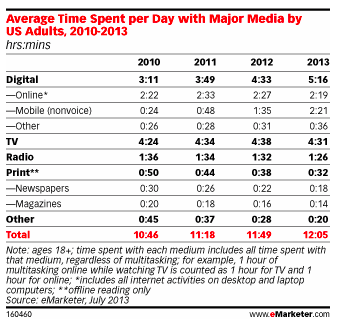
Consider the following research from emarketer.com.


The amount of time consumers spend daily engaged with digital media passed radio in 2009.  In 2013 it passed TV.  We (consumers) now spend more than five hours per day interacting with digital media.  From a consumer behavior perspective, digital became “traditional” or mainstream several years ago.


It is the marketers and advertisers that have lagged the marketplace.  Marketing is the art and science of targeting your message to the individuals who need or want your products and services.  Digital marketing offers a multitude of advantages over traditional media in targeting specific consumer segments.  But many advertisers are hesitant to engage in digital marketing - mostly because it is relatively new and they simply do not have experience in digital marketing, so they are reticent to recommend it to clients.  I am sure we went through a similar phase when TV came along and advertisers were afraid to reallocate money from radio.


I experienced a very similar struggle in the late 1990’s with Yellow Page advertising.  We conducted research that showed consumers simply were not using the Yellow Pages the same way as they did in the 1980’s.  But our clients (automotive franchisees) were terrified to pull money out of Yellow Page directories that had served them so well for so long.  For years, the Yellow Pages were the “go to” option for millions of consumers to find companies that offered the products and services they sought.


But consumer behavior changed.  Suddenly business owners discovered other mediums for sharing their message.  Direct mail went from non-existent to being a powerful way of targeting prospective consumers.  Unlike the Yellow Pages where you were forced to advertise to everyone in your city (perhaps hundreds of thousands of households), direct mail allowed you to target consumers by zip code.  If 90% of your business came from within a three mile radius of your shop, why waste your advertising dollars on the other side of town?


And then you had the ability to only mail to households within your three mile radius that owned an automobile.  Then households that owned an automobile that was at least three years old.  Ultimately, the franchisees understood that consumer’s behavior had indeed changed and we pulled millions of dollars out of the Yellow Pages and invested them into other advertising mediums - like direct mail.  But eventually direct mail’s effectiveness diminished when the consumer was receiving two pounds of direct mail and decided to simply throw it all in the trash.  


Successful advertising techniques are always in transition.  And once we find something that works, we are afraid to change it.  It is human nature.  


Just this week I was talking with a client about increasing his digital budget for an upcoming sales event.  His last bridal event was run in September and we targeted consumers on Facebook.  The results, based on driving traffic to his website, were terrific.  His target audience is brides.  One of the targeting options in Facebook is placing his ads in front of people that are engaged.  A great fit.


Now he has another show coming up and we recommended that he triple his investment in digital advertising.  His previous budget only allowed us to reach a small portion of the “brides” on Facebook.  But the ones we reached were on target for this event.  We did not ask him to triple the overall budget, only reallocate money from the radio and newspaper.


He chose to stay with the “traditional” advertising he had always used.  So I challenged him to call the radio group and ask them how many “engaged women” are  listening to their stations today.  And then ask the newspaper the same question.  I already know the answer - they don’t have a clue.  However, this is a great example of the power of digital marketing to target specific consumer groups.  Females.  Age 20-45.  Engaged.  Within a 50 mile radius of Toledo.


The second reason he stayed with the traditional media - “You wouldn’t believe the deal I got!  They really stepped up and gave me amazing rates.  I couldn’t afford to pass it up!”  More ads, cheaper ads, to the wrong audience is not a bargain.  

For the record, there are individuals matching the above targeting parameters that are listening to the radio and reading the newspaper.  You just can’t target those individuals as effectively as you can with digital.  

Wednesday, January 7, 2015

Digital Advertising, The Magic Wand

Well so much for truth in advertising.  There is no such thing as a magic wand.
Digital advertising works.  
And it works because when done properly, it is a lot of hard work.
I was meeting with a client outlining all the advantages of digital advertising.
Media consumption - consumers now spend more time with digital properties than TV.
Targeting - give me an accurate description of the consumer you are targeting and we can find them using targeted display, video, mobile, Facebook, Google...  We taught the NSA how to track consumers...
A/B testing and Optimization - we can run multiple offers on multiple websites at the same time, measure the results, re-investing your budget into the creative and properties that are performing the best - at will.
"Ok, I am sold!  I have been telling the boss, we need to take some of our direct mail money and invest it into digital.  I want to run a small campaign to show it works, then I will ask the boss for additional funding.  How about $1,000 for a test?"
No thank you.
"What?"
No thank you.  How much did you spend on your last direct mail campaign?  $40,000?  And by your own admission, it did not work.  Now you want to dip your toe into the digital water?  No thank you.  It is a recipe for failure.  
As an industry, we are past the "does it work" phase.  Digital marketing is here to stay.  "The very best marketing comes from observing consumer behavior and inserting your message into their behavior."  A $1,000 "test" isn't going to prove anything.  We know that digital works, what we need to uncover is which digital strategy is best for you and that takes time.  And money.  And effort.
There is no such thing as a magic wand.  "Wave the wand and all your advertising problems are solved."  No it takes strategy, planning, execution, analysis, optimizing to the results.  
As it turns out, successful digital advertising is a lot of work.

Monday, December 29, 2014

Five Digital Strategies Run Off the Cliff in 2015

"Don't worry about people stealing your ideas. If your ideas are any good, you'll have to ram them down people's throats." Howard Aiken
Apparently now is the time for prognosticating, so after a lot of contemplation and a three glasses of eggnog, here is what I see happening in 2015.
March. Mobile sites add more advertising inventory and drop content. By the time you read this the majority of web traffic will officially be mobile traffic. By March 6th, 2015, every one has frantically rebuilt their websites using responsive design, or at least they have added a mobile site to their digital mix in order to meet this change in consumer behavior. On March 7th, everyone realizes that while mobile site traffic is increasing exponentially, the average mobile site only has one 320x50 pixel ad per page. The average desktop site has 47 ad placements. So publishers immediately drop all content and replace it with advertisements in a frantic effort to make the 2015 sales budgets. "Thank goodness we caught this in time!", remarked one well known publisher.
Dateline May 10th... The Behavioral Targeting Riots start. Consumers have finally had enough of poorly executed behavioral targeting campaigns and take to the streets burning the buildings of the very companies implementing these campaigns. "At least the NSA follows me around in an unmarked van", cries one frustrated consumer. Fortunately each well designed splash page contains a Google Map making it easy to find these businesses. I still see targeted ads from a business I visited 1,056 days ago. And I only visited to get the address for a sales call. 
July. We run out of Hashtags. As everyone continues to invent new hashtags in a never dying effort to "keep cool" and build site traffic, on July 27th, 2015 we finally run out of hashtags. #OutOfHashtags, #ThankGodWeAreOutofHashtags Looks like we are going to have to invest in writing actual content to get noticed.
September. New Social Media Site Laws Take Effect. On Monday September 7th, in an effort to stop drunk and regrettable postings on all social media sites, Congress passes legislation forcing the deletion of all social media content within 7 seconds of posting, including any references involving congressmen since Fanne Fox and Wilbur Mills's 1974 misunderstanding in the Washington D.C Tidal Basin.
Christmas 2015. New Ad Tag guarantees you will get credit for sales attribution. Don't know why I didn't think of this earlier. On November 23rd, a new ad tracking tag goes live. Its sole purpose is to rewrite all existing ad tags with its own code as soon as you visit a web site, guaranteeing your campaign/website/program will get credit for the sale. 
Best wishes in the new year!
“When the whole world is silent, even one voice becomes powerful.” – Malala Yousafzai

Friday, November 7, 2014

"The internet is about to do to TV what it has already done to newspapers and radio."

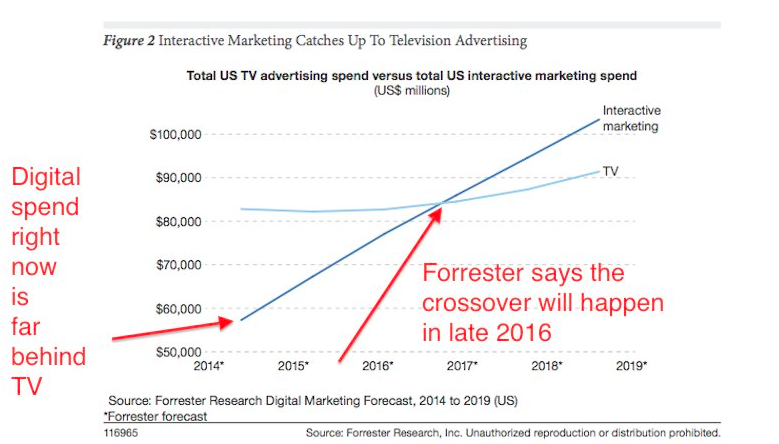
According to an article in the Business Insider, "The death knell for the primacy of TV advertising has been ringing for some time, but we now know when to arrange the funeral: 2016."

Even though I am a diehard digital marketer, TV will not die in 2016.  The prediction says that marketers will spend more money on digital than TV starting in 2016, but much like the calls for the "death of radio" when TV came along, I think that TV will continue to be a very effective medium for reaching and influencing a large segment of the population long after this revenue transformation occurs.


Consumers switched their dominant media preference from TV to digital in the fourth quarter of 2013.  Now the evidence indicates that advertisers will follow suit.  Agreed.

But TV isn't going anywhere (unless the broadcast industry kills it).  According to the article - It's worth pointing out that this evidence doesn't point toward the death of TV networks and broadcasters (they sell a lot of digital ads too), but that marketers are increasingly pivoting their spend to focus far less around the 30-second digital spot. So it's the end of TV's dominance, rather than the end of TV.

In a lot of ways digital spending will follow the same path as TV.  For years one of the problems with TV marketing has been the decline in ratings among the broadcasters. 
Viewers simply have more choices (channels) to watch than they did 20 years ago.  The ratings decline did not happen over night.  There was no new "channel" that interrupted consumer's behavior.  It was the death by a thousand paper cuts.  Here is a chart showing the ratings of the highest rated show each season for the previous 50 years.  Do you see the trend?


Ironically, digital marketers are experiencing a similar problem. The proliferation of the shear number web sites and social media sites makes the "ratings" or audience penetration of a single site smaller every year.  Where do we put this new found money in a rapidly expanding universe and still see a return on investment for our clients?  This helps explain the rapidly rising interest in programmatic buying.  Chase the audience, not the web site.  But click fraud will help quell this trend until we find a way to deal with it.

I'll stop here and address this issue later.  For now, TV is still going to work with for a lot of advertisers.  Not as well as it may have 20 years ago, but what does?

Wednesday, November 5, 2014

US Hispanic Mobile Buyers More Inclined to Buy, Research on Device

eMarketer reports "US Hispanic mobile buyers also are more inclined to use their devices to research products with online product reviews as their most valued resource. While 53% of Hispanic mobile buyers looked for online product reviews on their smartphones and tablets, just 44% of non-Hispanics did the same." 

For the savvy marketer, this simply reminds us that the "very best marketing comes from observing consumer behavior and inserting your message into their behavior".

Digital marketing has evolved to the point that we are hunting consumers, rather than simply waiting for them to find us. Everyday, it becomes more difficult to simply launch a web site and employ SEO tactics and see site traffic and sales rise.  Part of your marketing plan has to include digital hunting.  

One of the reasons programmatic buying is so scary for publishers is that it undermines the value buyers see in their web site.  For years we have sold our web sites as an "audience of 'fill in the blank' and the best way to reach this audience is to buy our web site.

Programmatic buying starts with the buyer "observing consumer behavior" determining the audience they want to "insert their message into their behavior".  They are buying specific consumer behaviors, not web sites.  If your web site contains these consumers, great.  If not, we are chasing behavior not web sites.  Pass.  

And in today's market, programmatic buying yields a lower CPM to the average publisher than selling the web site brand.

We have to change with the times and the technology.  As Will Rogers reminds us, “Even if you're on the right track, you'll get run over if you just sit there.”   

Tuesday, September 23, 2014

Spending on Digital Ads to Overtake TV in 2017

Spending on Digital Ads to Overtake TV in 2017

Magna Global said U.S. digital ad revenue would reach $72.0 billion in 2017, compared with TV ad spending of $70.5 billion. Last year, digital accounted for $43 billion, with Magna forecasting it will reach the $50 million mark this year. 

I think they meant $50 billion this year...


By comparison, digital media advertising is already bigger than total TV spending in such countries as the U.K., Australia, Germany and the Netherlands. The fact that digital isn't the biggest ad category in the U.S. "shows the strength and resilience of television in the U.S. compared to other advanced ad markets despite the current plateau in viewing," Magna said.

Nothing new here.  This trend has been apparent for several years now. Consumers already spend more time with their digital devices than their TV.  eMarketer reported in August 2013,  "The average adult will spend over 5 hours per day online, on non-voice mobile activities or with other digital media this year, eMarketer estimates, compared to 4 hours and 31 minutes watching television."

Advertisers (and the advertiser's money) are simply following the consumer's behavior.  

My surprise is that the flow of money has not moved to digital more quickly.  I am surprised that more marketers are not proactively taking advantage of this trend towards digital engagement.  This is a generational opportunity  to get in front of the largest change in consumer behavior since the launch of TV.  

You have to hand it to the broadcast and cable industry.  They have done an admirable job of hanging on to advertiser's budgets in the face of a dominating change in consumer behavior.  Of course over the long haul, I am convinced that this trend will reverse itself.  

As shown in the diagram below, the newspaper industry has not figured out how to successfully re-invent itself in the face of consumer change.

"At the American Enterprise Institute’s Carpe Diem blog, Mark J. Perry finds that print ad revenues are now the lowest they've been since 1950, when the Newspaper Association of America began tracking industry data."


Borrell Associates, in their 2014 Benchmarking Local TV Stations Online Revenue, talks about the importance of capturing digital in local markets to offset the impending loss of broadcast dollars.  

Much of the the good news in Broadcast TV comes from the relatively new (2008) explosion in retransmission fees.  These are fees that local broadcast stations now charge cable and satellite companies to rebroadcast their signal.  

The problem is that TV ratings continue to decline.  There are more programs and channels to watch than ever before.  But the net result of this fragmentation is that the audience watching an individual show continues to decline.  (Consumer behavior).  So the biggest hits of today (excluding special events like The Super Bowl) - NBC Sunday Night Football - generated a 12.8 rating last year.  In 1952, I Love Lucy generated a 67.3.  In the 1960's the highest rated show was Gunsmoke at a 40.3.  In the 1970's All In The Family topped the charts at a 34.0.  1980's - The Cosby Show was the only show that topped a 30 rating.  In the 1990's, ER generated a 22.0.  Notice a trend?  


Over the next few years, we are going to see an increased shift in advertising dollars into digital marketing.  And much of this shift will come at the expense of TV.  Look how the change in consumer behavior decimated the newspaper industry.  Most TV broadcasters have done an admirable job at trying to increase their expertise into the digital arena over the previous 5 years, but many are still saddled by a management team at the local market level that talks about the digital transition, but still lives and breathes TV, at the expense of digital revenue.  In many cases, digital, even their own products, is the competition.  

"The very best marketing comes from observing consumer behavior and insetting your message into their behavior."

Thursday, September 11, 2014

Facebook - I Knew It Would Work!


Social Marketing 

Interesting article on eMarketer.com today.  Paid Social Ads Convert More Customers.  


It turns out that paid ads are out performing organic content on Facebook.  "Paid ads on social networks do have better conversion rates than organic content."

I believe this is happening for two reasons.  First, the targeting abilities for Facebook continue to improve. Any information that you voluntarily added to your Facebook account - single, married, divorced, engaged, work, education, birthdate, gender, interests, relationships...  You get the idea...  Allows marketers to target you with ads.

Facebook's abilities to target specific consumer segments continue to deliver to advertisers.  For example, we used Facebook to target ads for a client sponsoring a "Wedding Expo".  Facebook allowed us to target single, engaged, females, 21-45, within 50 miles of Toledo.  This audience targeting allowed us to reduce the Facebook distribution from 380,000 "individuals" to 5,200 women who fit the target defined above. 

The second and equally as important a reason - "Mutability is life's sole constant" - is the changes Facebook makes in its algorithm for posting to your news feed.  When Facebook launched, everything you posted to your timeline was viewable to everyone connected to you through fans/likes.  As Facebook evolved its revenue model, it found it profitable to throttle back the number of followers that could view your postings into their timeline.  Today it is estimated that your posts are only able to be viewed by 16% of your followers. This "select 16%" is controlled by a complicated algorithm that weighs a variety of factors, but they try to weight your followers and display only the most pertinent posts to the followers they feel are the most connected to your post.

If you want more of your followers to see your newsfeed posts, you will need to use Facebook's Boost program.  After posting your message, you can click on the Boost icon on the bottom right of your post.  If you want to see how this works, follow this link for Facebook Boost.  In addition to boosting distribution to your own followers, Boost allows you to target new audiences based on - you guessed it - the information you surrendered to Facebook as you set up and modified your Facebook account.

So now you know how it pays to be social.  If you want to learn more, shoot me an email....  Jeff@ThriveIM.com.  

P.S. Just saw a great article that talks more about Facebook targeting...  Here is the link... 


What Facebook's Evolving Social Graph Means for Content Marketers

Read more: http://www.marketingprofs.com/opinions/2014/25933/what-facebooks-evolving-social-graph-means-for-content-marketers#ixzz3D2CfrSTF