Showing posts with label mobile device. Show all posts

Monday, February 9, 2015

Goodbye Menu Navigation

"Ok, grab a clean sheet of paper and let's write down everything we want in our new demo website."
"What's paper?"
That's not the exactly the way the meeting started, but you get the point. Technology is changing so fast, some days it is difficult to keep track of what is available and what is not.  Thrive IM is in the beginning of designing the next generation YMCA website.  A group of us were gathered around the conference room trying to beat John to the pizza.  
On the wall we were staring at the existing demo site on the 60" monitor. The problem we were discussing was navigation and sub-navigation.  From a user's perspective, how should the navigation flow?  What is the most logical progression that would let the site visitor find the information they needed in the most efficient manor? Horizontal navigation or vertical?  Fanned sub-nav or accordion?  
"I think we are looking at this from the wrong perspective.  We already know that traffic to YMCA websites is mirroring traffic to other sites.  More than 50% of existing website traffic to YMCA websites now comes from smartphones and tablets. The question we should be asking is how can consumers find the content they seek on a smartphone?"
And suddenly the answer was there.  Search.  Voice search.  You reach your local YMCA site and have a choice.  Start reading menu options and clicking on the navigation icon you "think" will reveal the answer, or...
Tap the microphone icon and ask the web site "When does summer camp start?" And almost instantly your smartphone takes you to the information you want on your local YMCA website .  Almost Watson-like, it reports "there is a 93% chance that the answer you seek is Friday, June 13th.  Would you like to register now?"
Sometimes we forget that a smartphone is still a phone.

Tuesday, January 13, 2015

The Interview Continues - Mobile Marketing

Part two - An interview with Deepak Kanakaraju and published on DigitalDeepak.com.  Due to the length, I will post the interview over a series of blog articles.


What are the top 3 things to look out for when it comes to mobile marketing?


Bonus time!  Here are five points to consider when marketing through mobile devices.


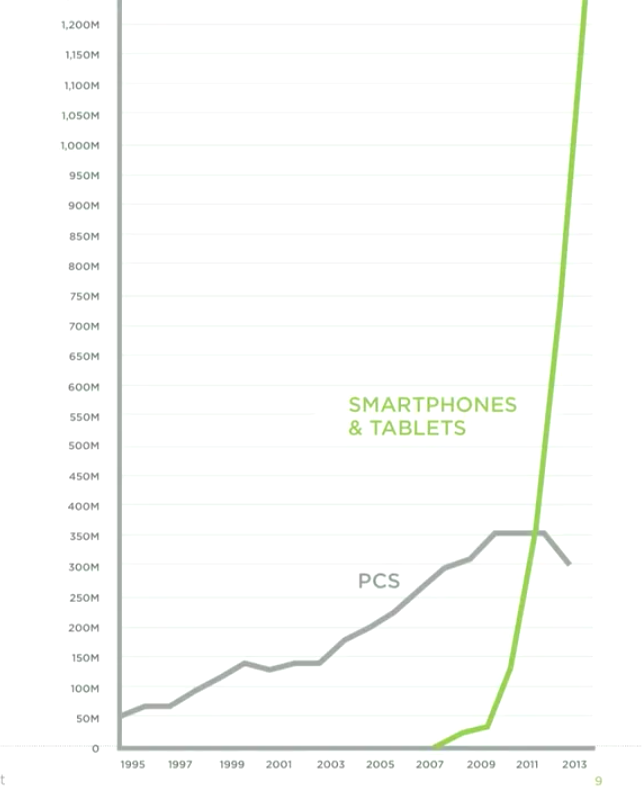
Mobile marketing will be the most important marketing trend over the next three to five years for a variety of reasons.  The biggest reason is that consumers are in control of the process.  Below is a graph that tells you how important mobile marketing is today.  PC sales peaked in 2011 at 350 million units worldwide after 29 years of sales (since 1983).  Seven years after launch, smartphones and tablets have sold more than 1.2 billion.


If you are not focused on mobile, you need to start now.  Next to the fact that everyone has a mobile device today, the biggest factors in mobile marketing are:


  • You must have a mobile website.  Websites designed for a width of 1920 pixels will not display on a smartphone, which on average has 320 pixels.  Or it will and be so small that the web site is useless.  Recently I did an analysis of 22 websites comparing the bounce rates of responsive versus non-responsive websites in the YMCA.  On average, the bounce rates for responsive (mobile friendly) websites were 14% lower than non-responsive web sites.
  • Develop specific mobile landing pages for your offer.  Mobile marketing is no different than traditional website marketing.  You must deliver the sales prospect to the information/product/service they are looking for in as few clicks as possible.  “Looking for X?  Click here.  Hello X!”
  • You must profile and target the right consumer.  Mobile targeting is rapidly becoming as efficient as desktop targeting, even without the use of cookies, using contextual targeting (based on matching the consumer’s interest with the website’s content) and geo-targeting (based on the physical proximity of the consumer to the business).
  • It costs more, but Location Based Mobile Advertising is worth it.  Also known as geo-fencing or geo-targeting, it gives the advertiser the ability to use the GPS functionality of today’s smart phones to target consumers.  Smartphones track where you go.  Own a restaurant?  You can erect an invisible, digital fence around your restaurant and advertise within a one mile radius of your location.  “Save $1 on any sandwich today!”  Or erect a fence around your competition.  Or target the football stadium for the after the game crowd.  Smartphones even keep a list of where you have been over the previous 60 days.  I have worked with new car dealers who target consumers who have visited two or more dealerships in the previous 60 days.  They know these individuals are in the market for a new car.
  • Finally - It’s a phone.  Smartphone. Take advantage of Click to Call.  Show an ad.  Take the prospect to a mobile landing page and tell them - press this button to talk now.  One of the smartest campaigns I have worked on was for a university, targeting high school students.  The landing page said “My name is Jeff.  I am your enrollment counselor.  Press here to talk to me.  Click here to send me an email.”  Three weeks into the campaign they had to add more counselors to handle the call volume.

When reporting on the increase in the consumer’s time spent with digital media, eMarketer reported, “The most significant growth area is on mobile. Adults will spend an average of 2 hours and 21 minutes per day on non voice mobile activities, including mobile internet usage on phones and tablets - longer than they will spend online on desktop and laptop computers, and nearly an hour more than they spent on mobile last year.”

Tuesday, November 25, 2014

Mobile Traffic Reaches 50%. Does it Matter?

“The very best marketing comes from observing consumer behavior and inserting your message into their behavior.”

Recently I reviewed the Google analytics for 22 YMCA web sites to identify consumer traffic trends for 2014.  Research from eMarketer indicates that consumers continue to move their web access device of choice to mobile (smartphones and tablets).  “Combining online and mobile devices, however, eMarketer expects US adults to spend 5 hours 46 minutes with digital media daily this year, increasing digital’s lead over television to well over 1 hour per day.  That increase is almost exclusively attributable to mobile.”

I wanted to see the impact, if any, on the traffic to YMCA websites. Many businesses are now reporting that more than 50% of their site traffic is coming from mobile devices.  It makes sense, smartphones have outsold computers since the 4th quarter of 2011.  

These analytics covered 2.1 million web sessions from January 1st to November 23rd, 2014.  

We Are Going Mobile

  • During the first six months of 2014, mobile traffic represented 46.2% of all traffic to these YMCA websites.
  • From July 1st to November 23rd, mobile traffic represented 49.4% of all traffic, an increase of 7%.  Clearly consumers are increasing their use of mobile devices to access YMCA websites.
  • Seven of the 22 web sites already generate more than 50% of their traffic from mobile devices.
  • Based on current trends, it appears that mobile traffic will account for more than 50% of all YMCA traffic by the end of the first quarter of 2015.

Does It Matter?

What does this change in traffic mean to the “average” YMCA, if anything? This analysis includes a cross section of YMCA sites: 14 traditional web sites and 8 responsive design (mobile friendly) websites.

Mobile traffic for responsive design websites increasingly represents a larger portion of total site traffic.  Mobile traffic in responsive design sites is 46.7% of all traffic versus 45.8% of non-responsive sites. When consumers have a more engaging experience, they will visit more often and stay longer.

This may be a small difference, but the real difference comes from looking at the variances in bounce rates.


Bounce Rates


January - June
Traditional
Responsive
Variance
Smartphones
53.40%
46.70%
14%
Tablets
44.70%
37.90%
18%


July - November 23rd
Traditional
Responsive

Smartphones
54.40%
47.68%
14%
Tablets
44.44%
39.57%
12%


Clearly the bounce rates are lower for responsive design sites. Responsive (mobile friendly) design leads visitors more easily to the content they are seeking.  

Your website is your digital storefront and for many member prospects it is their first impression of your organization.  Upgrading your website to responsive design (or at least offering a mobile site) is no longer an option. Consumer behavior now dictates it.

Friday, November 21, 2014

Turning Mirrors Into Windows


comScore reported in June that 60 percent of all online traffic now comes from mobile devices.

That is a 50 percent increase from the previous year.


Over the previous four weeks I have reviewed approximately 60 web sites for clients and prospective clients and none (zero) have a mobile friendly web site.  So I asked them what their plans were to make their websites mobile friendly for their clients and their sales prospects.  Here is a fairly typical response...

"Thanks so much for getting in touch.  We did redesign our website a few years back and are currently happy with it.  There are areas for improvement, but it isn't our priority this year or next year."

Ian Hartten is found of reminding me that we have "elected to join the fastest changing industry in history".  At times I admit that it is difficult to keep pace with all the changes.  But as digital marketers, it is our burden to keep pace.  And "the very best marketing comes from observing consumer behavior and inserting your message into their behavior".

Everyone I spoke to believed people were using mobile devices to access the web, but all were shocked at the accelerated pace at which this phenomenon had occurred.  Their decision to not have a mobile friendly website was not a conscious decision. It was a "sin of omission".  They simply did not realize how fast this change in consumer behavior had come about.

Mobile web traffic was measured at 20 minutes per day in 2010. By 2013 it rivals the amount of traffic generated by desktop devices, almost a full two hours per day more than in 2010.


This represents the fastest adoption of a media device in history. 

They didn't know because we hadn't told them.  A large part of working in the "fastest changing industry in history" is sharing knowledge.  Education.  Its all part of the job.

Be sure and share what you learn with others.  

"The whole purpose of education is to turn mirrors into windows."  Sydney J. Harris


Wednesday, March 19, 2014

Do People Really Watching Video on a Mobile Phone?


Recently a client asked me, "Do people really watch video on a smartphone?  Maybe kids, but certainly not people the age of my clients."  
 
Sorry, but the answer is yes they do.
 
Below is information from an article on eMarketer.com on this topic.  It is dated Q2 2012, so I imagine the numbers have continued to grow.

Among other findings:
  • The growth of the mobile video audience is impressive. eMarketer expects the number of smartphone video viewers in 2014 to hit nearly 87 million, or more than one-quarter of the total US population.”
  • “In Q2 2012, the average US mobile subscriber spent 5 hours and 20 minutes per month watching video on a mobile phone, according to Nielsen.”
  •  Mobile video advertising serves several potential objectives and offers a number of possible benefits for marketers, including: It cuts through the clutter.”
  • “Multitasking is the enemy of branding. The requirements for branding include full-screen, immersive content,” said Ujjal Kohli, CEO at Rhythm NewMedia. “The stunning thing about tablets and smartphones is that somehow these systems have been designed to single-task when video is played. And it’s full-screen.”
As you can see in the chart below, the “average” consumer spends 5 hours and 20 minutes per month watching video on a mobile phone.  And while consumers ages 12-17 age lead the way with 7 hours 10 minutes per month, every age group admits to spending time watching video on a mobile device.  This research is one of the reasons we are streaming our newscasts online. 

 
“The very best marketing comes from observing consumer behavior and inserting your message into their behavior.”