Showing posts with label advertising. Show all posts

Thursday, February 26, 2015

Consumer Behavior - Key Metrics By Device

"The very best marketing comes from observing consumer behavior and inserting your message into their behavior."

Whether you operate a YMCA or other business, mobile is here to stay.  What is not certain is whether or not the desktop will be here in any measurable way in five years.  Mobile marketing will dominate website access because consumers are in control. Simply put, consumers are buying mobile devices, not PCs.

PC sales peaked in 2011 at 350 million units worldwide after 29 years of sales (since 1983). Seven years after launch, smartphones and tablets have sold more than 1.2 billion units.

On June 29th, 2007 the iPhone was introduced to the world. Today one third of all high school students have an iPhone.  

eMarketer has just published their Chart of the Week showing Key Metrics by Device for the 4th quarter of 2014


Based on the 2014 holiday selling system, it confirms what we already suspected.  

Mobile devices now account for 44.3% of all web traffic, but 75% of revenue still comes from desktop devices.  There is something comfortable about the desktop when it comes to placing an online order.

But the tablet is rapidly becoming a device of choice. Average time of site for a tablet (a sign of engagement) is 4:34 versus 4:38 for the desktop. The average pages per visit gap is also tightening up - 8.3 pages for the desktop, versus 7.3 for the tablet.  And the bounce rate for desktops is 33% versus 37% for the tablet.

Is it possible that consumers are doing the research on a tablet and then placing the order on the desktop?  Maybe not.  The average order value on a desktop is $133.17 and $131.07 for the tablet.  

I suspect that by the fourth quarter of 2015, the tablet may be clear winner, especially since tablet and "phablets" continue to outsell the traditional desktops.

Smartphones generate twice the traffic of tablets, but slightly less revenue than the tablet.  This supports the notion that consumers are using smartphones as research devices while visiting stores and shops. This is another trend that will change as the consumer feels more secure about retail transactions on mobile devices.  

The lesson to be learned?  Mobile commerce is here. You have no choice - your website must be mobile friendly and increasingly this means responsive web design.

Or your business will be left behind.  "Mutability is life's sole constant."


Monday, January 19, 2015

The Fallacy of Focus Groups

Another headline ripped out of Harry Beckwith's Selling the Invisible. If you have read any of my other posts, you know I am in my annual re-read of one of my top five favorite books of all time. Thanks again Harry!
The idea of a focus group seems solid. Gather a group of consumers. Show them your brilliant idea. Let them tell you why it will never work, never sell, never go anywhere.
There are several well known problems with focus groups.
  • A dominant personality can overshadow others in the group. There goes the group feedback.
  • Focus groups are conducted in an artificial environment which can make it difficult to extrapolate the results into the real world.
  • Forward thinking is not a strong suit for focus groups. To my knowledge, no significant new product or service has ever been championed by a focus group. In fact I shudder to think the ideas that have been mauled to death by a focus group.
Which brings me to Dan ConettaDan is an individual who has greatly influenced my thinking over the previous 30 years.
I was working for Dan in the convenience store business 30 years ago as a merchandiser. I was young and anxious to make a good impression. So almost everyday I would visit the competition and see what new products they were rolling out. "Dan - 7-11 is trying a deli at the the store on 49th Avenue." "Dan - Stop and Go has an ATM at their beach location." I am fairly certain I was wearing him out when he called me into his office one day.
He wanted to know why I was so obsessed and spending so much time watching the competition. I told him I was looking for good ideas for our stores. Revenue generators!
And to this day I remember what he taught me. Jeff - you are playing follow the leader. Just because the competition does something does't mean that we should. The danger of playing follow the leader - what if the leader is an idiot? The companies you are following are a lot bigger than we are. They can afford to make mistakes that we can't.
You are a smart guy. Wouldn't you rather succeed or fail based on programs you developed, rather than copying someone who may be an idiot? There is nothing wrong with failure, as long as you learn from it and don;t make the same mistake twice.
Why don't you channel this energy in a new direction. Let's focus on the following the customer. See how they behave and then develop our own products and services based on their behavior - not the competition.
"The very best marketing comes from observing consumer behavior and inserting your message into their behavior."
This approach has worked for thirty years and it appears it is still working. Focus on the consumer's behavior.  I think I will stick with it.

Monday, January 12, 2015

Interview With a Vampire - Actually a Digital Marketer

Recently, I was asked to participate in an online interview conducted by Deepak Kanakaraju and published on DigitalDeepak.com.  Due to the length, I will post the interview over a series of blog articles.


Interview With Jeffrey Davis - Digital Marketing Specialist


Today we have an important guest in our blog! Jeffrey Davis has 25+ years of experience in marketing and more than 15+ years in the digital marketing space. He is the Digital Marketing Strategist for Thrive Internet Marketing. He is an expert in targeting consumers online using targeted display ads, video and mobile. Today we will ask him a few questions and learn from his extensive experience.


Traditional Marketing Vs. Digital Marketing. What are your first thoughts about this?


Digital Marketing is Traditional Marketing.  At least today it is.  25+ years ago I learned a basic tenet of marketing that has served me well ever since.  “The very best marketing comes from observing consumer behavior and inserting your message into their behavior.”  


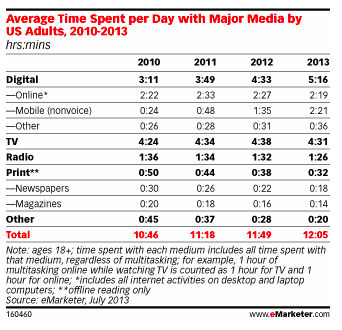
Consider the following research from emarketer.com.


The amount of time consumers spend daily engaged with digital media passed radio in 2009.  In 2013 it passed TV.  We (consumers) now spend more than five hours per day interacting with digital media.  From a consumer behavior perspective, digital became “traditional” or mainstream several years ago.


It is the marketers and advertisers that have lagged the marketplace.  Marketing is the art and science of targeting your message to the individuals who need or want your products and services.  Digital marketing offers a multitude of advantages over traditional media in targeting specific consumer segments.  But many advertisers are hesitant to engage in digital marketing - mostly because it is relatively new and they simply do not have experience in digital marketing, so they are reticent to recommend it to clients.  I am sure we went through a similar phase when TV came along and advertisers were afraid to reallocate money from radio.


I experienced a very similar struggle in the late 1990’s with Yellow Page advertising.  We conducted research that showed consumers simply were not using the Yellow Pages the same way as they did in the 1980’s.  But our clients (automotive franchisees) were terrified to pull money out of Yellow Page directories that had served them so well for so long.  For years, the Yellow Pages were the “go to” option for millions of consumers to find companies that offered the products and services they sought.


But consumer behavior changed.  Suddenly business owners discovered other mediums for sharing their message.  Direct mail went from non-existent to being a powerful way of targeting prospective consumers.  Unlike the Yellow Pages where you were forced to advertise to everyone in your city (perhaps hundreds of thousands of households), direct mail allowed you to target consumers by zip code.  If 90% of your business came from within a three mile radius of your shop, why waste your advertising dollars on the other side of town?


And then you had the ability to only mail to households within your three mile radius that owned an automobile.  Then households that owned an automobile that was at least three years old.  Ultimately, the franchisees understood that consumer’s behavior had indeed changed and we pulled millions of dollars out of the Yellow Pages and invested them into other advertising mediums - like direct mail.  But eventually direct mail’s effectiveness diminished when the consumer was receiving two pounds of direct mail and decided to simply throw it all in the trash.  


Successful advertising techniques are always in transition.  And once we find something that works, we are afraid to change it.  It is human nature.  


Just this week I was talking with a client about increasing his digital budget for an upcoming sales event.  His last bridal event was run in September and we targeted consumers on Facebook.  The results, based on driving traffic to his website, were terrific.  His target audience is brides.  One of the targeting options in Facebook is placing his ads in front of people that are engaged.  A great fit.


Now he has another show coming up and we recommended that he triple his investment in digital advertising.  His previous budget only allowed us to reach a small portion of the “brides” on Facebook.  But the ones we reached were on target for this event.  We did not ask him to triple the overall budget, only reallocate money from the radio and newspaper.


He chose to stay with the “traditional” advertising he had always used.  So I challenged him to call the radio group and ask them how many “engaged women” are  listening to their stations today.  And then ask the newspaper the same question.  I already know the answer - they don’t have a clue.  However, this is a great example of the power of digital marketing to target specific consumer groups.  Females.  Age 20-45.  Engaged.  Within a 50 mile radius of Toledo.


The second reason he stayed with the traditional media - “You wouldn’t believe the deal I got!  They really stepped up and gave me amazing rates.  I couldn’t afford to pass it up!”  More ads, cheaper ads, to the wrong audience is not a bargain.  

For the record, there are individuals matching the above targeting parameters that are listening to the radio and reading the newspaper.  You just can’t target those individuals as effectively as you can with digital.  

Wednesday, January 7, 2015

Digital Advertising, The Magic Wand

Well so much for truth in advertising.  There is no such thing as a magic wand.
Digital advertising works.  
And it works because when done properly, it is a lot of hard work.
I was meeting with a client outlining all the advantages of digital advertising.
Media consumption - consumers now spend more time with digital properties than TV.
Targeting - give me an accurate description of the consumer you are targeting and we can find them using targeted display, video, mobile, Facebook, Google...  We taught the NSA how to track consumers...
A/B testing and Optimization - we can run multiple offers on multiple websites at the same time, measure the results, re-investing your budget into the creative and properties that are performing the best - at will.
"Ok, I am sold!  I have been telling the boss, we need to take some of our direct mail money and invest it into digital.  I want to run a small campaign to show it works, then I will ask the boss for additional funding.  How about $1,000 for a test?"
No thank you.
"What?"
No thank you.  How much did you spend on your last direct mail campaign?  $40,000?  And by your own admission, it did not work.  Now you want to dip your toe into the digital water?  No thank you.  It is a recipe for failure.  
As an industry, we are past the "does it work" phase.  Digital marketing is here to stay.  "The very best marketing comes from observing consumer behavior and inserting your message into their behavior."  A $1,000 "test" isn't going to prove anything.  We know that digital works, what we need to uncover is which digital strategy is best for you and that takes time.  And money.  And effort.
There is no such thing as a magic wand.  "Wave the wand and all your advertising problems are solved."  No it takes strategy, planning, execution, analysis, optimizing to the results.  
As it turns out, successful digital advertising is a lot of work.

Friday, January 2, 2015

The Fact Is, Emotions Won Over Facts

Last night the Ohio State Buckeyes beat the Alabama Crimson Tide in the Sugar Bowl.  And naturally the only thing I could think of after the game at 12:30 am was marketing.  
For weeks I have been hearing how Alabama was a 9 point favorite.  The oddsmakers analyzed both teams - strengths and weaknesses - and Alabama looked like a sure lock.  The smart Crimson Tide followers have already bought tickets to next week's "2015 DI Football Championship Game".  "Beat the rush.  Book now!"
But a funny thing happened.  The nine point underdogs, under the leadership of Urban Myer and company, showed up and played for the entire 60 minutes the game was scheduled.  And they prevailed.  Emotion seemed to fly in the face of facts.  The pre-game analytics were clear.  Alabama should have won the game.
If you watched the game at least half of the stadium was wearing the scarlet and grey of Ohio State.  Didn't they know that OSU had no chance of prevailing?  Didn't they have access to the same media (TV, radio, online, print) that had already given the victory to Alabama?  Were they that ignorant of the facts?  
Facts versus emotion.  No fact or set of facts, could convince an individual swaddled in scarlet and grey that Ohio State didn't have a chance. Anymore than a fresh set of facts could have convinced the Crimson Tide that their team could not prevail.
Which brings us back to marketing. All to often we marketers lean on facts, when we should be focusing on emotion.  Consumers rarely make up their minds based on being overwhelmed by facts.  But wrap them in emotion and their hearts, minds and wallets will follow.
The Ohio State fans that "knew" their team would win were not ignorant.  They saw the facts.  They simply choose to follow their hearts.  
"People don’t ask for facts in making up their minds. They would rather have one good, soul-satisfying emotion than a dozen facts." – Robert Keith Leavit
Consumers want to believe.  They want to hear an emotional filled story on why they should believe what you are trying to sell them.  
Not facts.  Not a David Letterman "Top 10 List of the Reasons Campbell Chicken Noodle Soup is better than Brand X...."  Not another "Anniversary Sale!"  Not another "We Pay the Sales Tax" promotion.  Tell me a story.
So the next time you are preparing a campaign for a client, remember how 50,000 members of the Buckeye Nation showed up, in the face of facts, for a game that no one thought they could win.  And nothing you could tell them would convince them otherwise.
Tell me a story.
"The biggest emotion in creation is the bridge to optimism."  Brian May

Wednesday, November 5, 2014

Merry Christmas

Below is a link to one of my all time favorite advertisers and the history of their Christmas ads.  Storytelling at its finest.

Enjoy.

John Lewis' Christmas ads 2007 to 2013: from humble roots to national event


Friday, October 17, 2014

The Law of Leadership

In Al Ries & Jack Trout's 1993 marketing classic - The 22 Immutable Laws of Marketing - Violate Them At Your Own Risk - the very first law is The Law of Leadership.  

"The basic issue in marketing is creating a category you can be first in."


Being first is a commanding position to occupy, especially as time goes on.  They go on to ask a fairly simply question, "What's the name of the first person to fly across the Atlantic Solo?"  

Charles Lindbergh.

Who was the second?  I sense silence.  

With every client, I spend time asking them what makes them different than the competition.  And I preface it by saying the answer is not "great employees, marvelous customer service, family owned, years in business, etc."  Everyone says these things, so no one can own this positioning.  It turns out that answering the question "what makes you better than the competition" is harder to answer than you think.  And for the record, few consumers really care how long you have been in business (it didn't help Montgomery Wards), they don't care that you are family owned, and they don't believe all of your employees are the very best.

What can you tell your clients and prospects about you and your business that makes you number one in their eyes?  

Frequently the answer stares you in face.  It can be a fact that everyone already knows, but nobody is claiming ownership of it.  In the pizza business it might be "We deliver rain or shine." Do all pizza companies deliver rain or shine?  Of course.  But if you are first to claim this position, you have the chance to own the position in the mind of the consumer.  When the other pizza chains start advertising that they also deliver rain or shine, are they leading or following?  In the pizza business today, you have to deliver.  Why not position yourself as the leader in delivery? 

What service do you provide that is important in the mind of your clients?

When you think of fast food and breakfast, who do you think of?  McDonald's.  They pioneered drive through breakfast.

If I say Pizza, Pizza, you think of Little Caesars.  At least around here.

The point is, find a relevant point about your business where you can be seen as a leader and claim it.  And keep in mind, if you don't tell the prospect/client, you will not receive credit.  

By the way, Bert Hinkler was the second person to fly solo across the Atlantic.


Friday, October 3, 2014

Google 4 Wheel Drive Diversified

I was reading an article earlier today that talked about how you no longer needed to put a "Click Here" button in a display ad. "People know that you can click on an ad and it will take you to there advertiser's web site."  And it got me to thinking...

When I worked for the Local Fox Toledo station, I had a client who ran the most interesting TV campaign that I was ever involved with.  He bought short TV commercials - 5 seconds as I remember.  The message was easy to remember.  "Google 4 Wheel Drive Diversified".  

He knew he did not have a large budget and could not afford 30 second TV spots.  He could not pick and choose when his spots ran.  So he gave me a budget and said every time you can run one of my spots, do it.  Some months he had 100 spots.  Some he had 17.  And his web address was difficult to get out in 5 seconds and it certainly wasn't easy to remember - www.divtrk.com.

But he knew that Google would remember the address for him.

And the campaign drove a lot of traffic to his web site.

So I am going to try to use this approach in a digital format. For a client (to be named later) I am going to run a targeted display campaign that says "Need help with...  Google insert a client's name here".  To drive traffic to the client's web site.  

Bet it works.  I'll report back.

"Cruise it, use it or abuse it."


Tuesday, September 23, 2014

Spending on Digital Ads to Overtake TV in 2017

Spending on Digital Ads to Overtake TV in 2017

Magna Global said U.S. digital ad revenue would reach $72.0 billion in 2017, compared with TV ad spending of $70.5 billion. Last year, digital accounted for $43 billion, with Magna forecasting it will reach the $50 million mark this year. 

I think they meant $50 billion this year...


By comparison, digital media advertising is already bigger than total TV spending in such countries as the U.K., Australia, Germany and the Netherlands. The fact that digital isn't the biggest ad category in the U.S. "shows the strength and resilience of television in the U.S. compared to other advanced ad markets despite the current plateau in viewing," Magna said.

Nothing new here.  This trend has been apparent for several years now. Consumers already spend more time with their digital devices than their TV.  eMarketer reported in August 2013,  "The average adult will spend over 5 hours per day online, on non-voice mobile activities or with other digital media this year, eMarketer estimates, compared to 4 hours and 31 minutes watching television."

Advertisers (and the advertiser's money) are simply following the consumer's behavior.  

My surprise is that the flow of money has not moved to digital more quickly.  I am surprised that more marketers are not proactively taking advantage of this trend towards digital engagement.  This is a generational opportunity  to get in front of the largest change in consumer behavior since the launch of TV.  

You have to hand it to the broadcast and cable industry.  They have done an admirable job of hanging on to advertiser's budgets in the face of a dominating change in consumer behavior.  Of course over the long haul, I am convinced that this trend will reverse itself.  

As shown in the diagram below, the newspaper industry has not figured out how to successfully re-invent itself in the face of consumer change.

"At the American Enterprise Institute’s Carpe Diem blog, Mark J. Perry finds that print ad revenues are now the lowest they've been since 1950, when the Newspaper Association of America began tracking industry data."


Borrell Associatesin their 2014 Benchmarking Local TV Stations Online Revenue, talks about the importance of capturing digital in local markets to offset the impending loss of broadcast dollars.  

Much of the the good news in Broadcast TV comes from the relatively new (2008) explosion in retransmission fees.  These are fees that local broadcast stations now charge cable and satellite companies to rebroadcast their signal.  

The problem is that TV ratings continue to decline.  There are more programs and channels to watch than ever before.  But the net result of this fragmentation is that the audience watching an individual show continues to decline.  (Consumer behavior).  So the biggest hits of today (excluding special events like The Super Bowl) - NBC Sunday Night Football - generated a 12.8 rating last year.  In 1952, I Love Lucy generated a 67.3.  In the 1960's the highest rated show was Gunsmoke at a 40.3.  In the 1970's All In The Family topped the charts at a 34.0.  1980's - The Cosby Show was the only show that topped a 30 rating.  In the 1990's, ER generated a 22.0.  Notice a trend?  


Over the next few years, we are going to see an increased shift in advertising dollars into digital marketing.  And much of this shift will come at the expense of TV.  Look how the change in consumer behavior decimated the newspaper industry.  Most TV broadcasters have done an admirable job at trying to increase their expertise into the digital arena over the previous 5 years, but many are still saddled by a management team at the local market level that talks about the digital transition, but still lives and breathes TV, at the expense of digital revenue.  In many cases, digital, even their own products, is the competition.  

"The very best marketing comes from observing consumer behavior and insetting your message into their behavior."

Wednesday, August 27, 2014

The Law of Familiarity

What makes marketing work? Invoking the Law of Familiarity.

Marketing is the process of getting your message in front of a qualified sales prospect multiple times

(Marketing automation is the process of getting your message in front of a qualified sales prospect multiple times with little or no work on your part.)

Multiple touch points builds Familiarity.

The Law of Familiarity
The Law of Familiarity shows us that the first step in securing a new customer is that your brand must be familiar to them.  The  more familiar you are, the more likely they will give you a chance to do business with them.


Familiar Means Safe
Who makes the best hamburger in your town?
McDonald’s?  Not a chance.
In Toledo it is Burger Bar.  Or Bar 145.
No one would select McDonald’s.
Now imagine you are on vacation and driving the family to the beach.
You pull off the interstate for lunch.  On the left is a local restaurant - Burger Bar.
On the right is a McDonald’s.  
Which do you pick?
McDonald’s.
Why? Because it is safe.  You know it is not the best, but you know what to expect.


This is The Law of Familiarity.

Familiarity Takes Time
Have you ever heard a song that you liked enough to buy the CD?
And you took it home (or downloaded it) and listened to it?
Only to think the rest of the CD “sucks”?
But you continued to listen it?
Soon you knew the words to the third track.
Then the seventh track started sounding pretty good.
Before you know it, “This is a great CD!”

This is The Law of Familiarity.

Familiar Means Taking Action

Ever wonder why politicians spend so much just advertising their name?  
What other "business" do you know that would use thousands of yard signs?
Do you really know anything about the person running for the Clerk of Courts?  Appellate Judge?  City Clerk?
Politicians know that when a voter goes into the booth,  they will pull the lever for the name they recognize, regardless of whether or not they know anything about the candidate.  Advertising works.  

And at Decision Time, Familiarity Wins.

This is The Law of Familiarity.

In today's fast paced, results oriented environment, it is easy to over look this important marketing truth, but your sales results will be greatly enhanced if you adhere to this proven technique.

Friday, August 8, 2014

Video Killed The Radio Star

This is scary....  

A study released this week by video library management company Levels Beyond...

  • 59% of consumers are likely to watch branded video on a company website. 
  • Similarly, 71% of marketers agree that brands should be video content producers. 
  • However, 75% of marketers say that producing video is not a priority for their company, with 40% claiming their brand rarely uses video.
"The very best marketing comes from observing consumer behavior and inserting your message into their behavior."

For some reason, all I can picture is "This is your brain.  This is your brain on drugs.."

"Wake Up America."  - Billy Cunningham

Friday, May 30, 2014

The 6 Most Clever Marketing Stunts of 2014 - So Far


Fellow Marketers
Sometimes we get so involved in advertising we forget about marketing.  It is about more than advertising.  Sometimes marketing ideas can generate more response then the very best ads.  This is the very definition of viral marketing.

I knew I would have to share this article as soon as I saw it earlier today in the Marketing Dive.  The 6 most clever marketing stunts of 2014 (so far).  Amazon seems to always find ways to catch competitors off guard….  But the DHL stunt is my favorite… 

By Wendy Parish
May 30, 2014 |


If there’s one thing the marketing world loves to do, it’s pull off a stunt. Some are successful, while others just come off looking kind of silly – but all offer their own lessons. We’re only midway through 2014, but the year has seen no shortage of brands tapping into their creativity to grab the attention of media and consumers alike.
Here are six of the most clever stunts we’ve seen in 2014 so far.

 1. Pornhub’s G-rated search for a creative director
Typically, adult brands keep to themselves and spend their time advertising on like-minded sites, hoping to attract viewers already looking at similar material elsewhere.  With views becoming a little more relaxed, however, Pornhub decided to venture into mainstream advertising with a G-rated ad campaign.
With the site also on the lookout for a new creative director, what better way was there to vet candidates than by launching a competition to create that very campaign? Over 1,200 safe-for-work entries were received, and the playing field has since been narrowed down to 15 finalists, whose work was posted on Pornhub’s Tumblr for followers to vote on.
Aside from vetting candidates, the contest provided Pornhub a wealth of content that it can now disperse through social media. 


2. Amazon’s big orange locker

Amazon is no stranger to a good stunt. Remember the drones? Not one to rest on its laurels, Amazon dropped a huge orange locker in front of San Francisco’s iconic Ferry Building earlier this month. Initially unmarked aside from an Amazon logo, the locker remained a mystery for a few days while the online retailer stayed mum on its contents. Eventually, the hashtag #giantlocker and a Nissan logo were added to the side of the container, stoking social media conversation.
Ultimately, the stunt was part of a partnership to promote the new Nissan Rogue. Those using the hashtag on social media would be entered to receive codes corresponding to different prize-filled compartments on the locker, with the ultimate prize being a Nissan Rogue.
Nothing creates viral gold like a mystery. And prizes. 

https://www.youtube.com/watch?feature=player_embedded&v=NE9ujQ1zJos


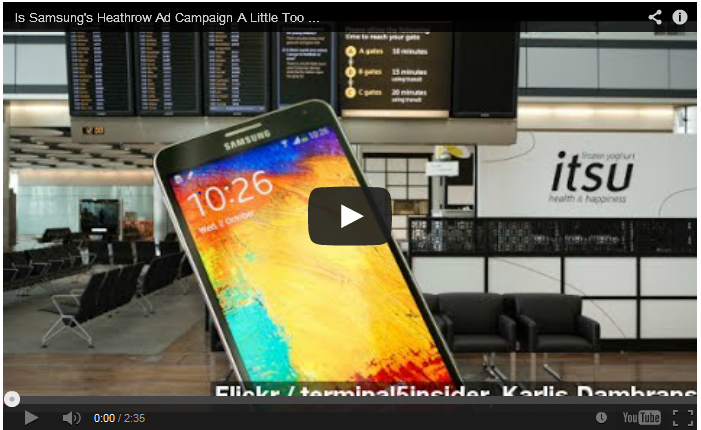
3. Samsung rebrands Heathrow Airport terminal

For two weeks this year, travelers using Terminal 5 in London’s Heathrow Airport, were greeted with a Samsung overload. The Korean electronics company had rebranded the area “Terminal Samsung Galaxy 5.”
The new name was meant to promote the new Galaxy 5 smartphone in what is the busiest terminal in one of the world’s busiest airports. Needless to say, a whole lot of eyes saw Samsung’s signage. The brand also had reps set up in the terminal to demo the device.
The deal was the first of its kind – no other brand has ever temporarily renamed an airport terminal or taken over all signage in one wing.

https://www.youtube.com/watch?v=sAdkREQ4144&feature=player_embedded


4. Doritos photobombs the Super Bowl

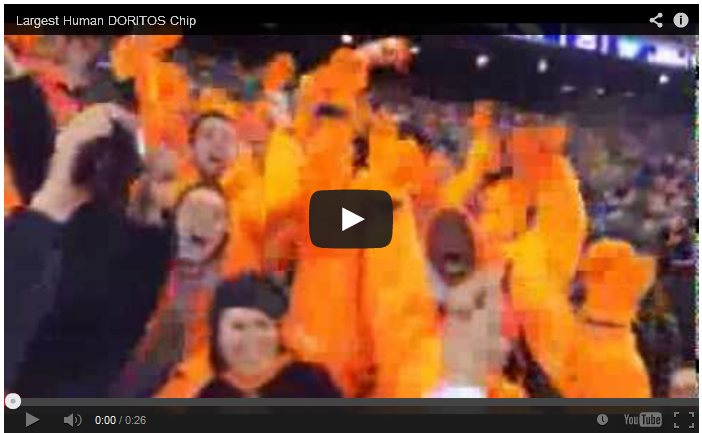
A 30-second Super Bowl commercial this year ran about $4 million dollars. Looking to sidestep that hefty price tag, Doritos crafted a stunt that helped it cash in on the hype while saving millions.
The brand enlisted 30 people in one section of the crowd to wear orange, planning it so they were arranged in the shape of a Dorito. From afar, that section did bear resemblance to one of the popular nacho cheese chips.
The stunt garnered Doritos thousands of retweets and favorites on Twitter. In addition to its social media success, the stunt resulted in record from RecordSetter.com for the World’s Largest Human Dorito.

https://www.youtube.com/watch?v=91DiaAoVH8M&feature=player_embedded

5. DHL gets rivals to deliver marketing messages
DHL pulled off a rather ruthless stunt a few months ago when it turned rival delivery drivers into its own walking advertisements.
The company had large boxes wrapped with thermo-active foil that, when chilled below a certain temperature, turns black. When delivery drivers from UPS and TNT picked up the packages, they couldn’t see the messaging on the chilled boxes. As the boxes warmed up, they displayed the message “DHL is faster.” In order to give the foil time to warm up, the addresses for delivery were intentionally difficult to find and maneuver a huge box to.
In a statement to the Consumerist, DHL denied having direct involvement with the prank, which it said was part of an internal competition by an external agency. DHL says it knew about the stunt, but didn’t know the video would be made public. Despite the questionable authenticity, it’s undeniable that the video’s quick ascent to viral status scored plenty of attention for DHL. 

https://www.youtube.com/watch?v=vHVWegNfQl0&feature=player_embedded

6. Match.com’s dog-food-scented posters

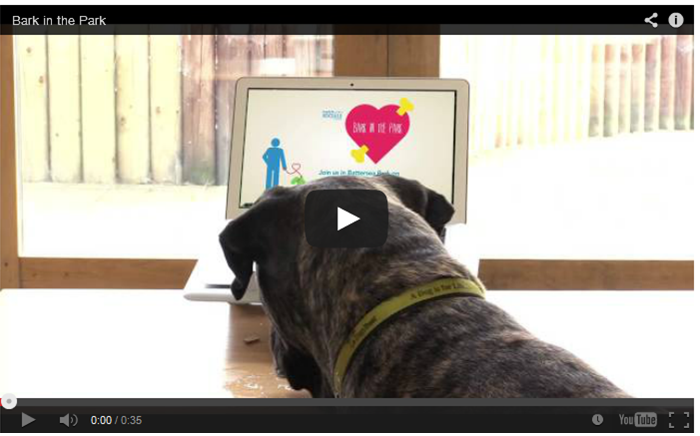
In an effort to find more ways for singles to meet in real life, Match.com launched a series of social events to bring people with similar interests together. The first of those events was aimed at dog-owning singles.
In order to promote the “Bark in the Park” event, Match.com created a bunch flyers and put them around London’s Battersea Park. On its face, that doesn’t seem like a clever marketing stunt, but it’s the composition of the posters that makes this promotion unique – they were all scented like dog food in order to draw in walkers’ dogs and make it impossible to avoid seeing the event’s details.
By essentially marketing to dogs, Match indirectly reached their owners in its bid to attract more singles to its match-making service.

https://www.youtube.com/watch?feature=player_embedded&v=1Q8LziFisNw